Zibo City, Shandong Province

Have Any Questions?

10 AM – 6 PM
Zibo City, Shandong Province
Have Any Questions?
10 AM – 6 PM

Have Any Questions?

In the rush to launch a product, the "tooling phase" is often the black hole of the schedule. I have seen many project managers account for production time and shipping time, but completely forget the time required to actually build the machines that make the packaging. Whether it is a simple steel blade for a cardboard box or a multi-ton steel block for a plastic bottle, nothing happens until the tooling is ready.
Understanding the lead time for packaging molds and dies is essential for accurate project management. It is the bridge between your digital design and physical reality. In this guide, I will break down the typical timelines for different types of tooling, explain the risks of "concurrent processing," and share my strategies for ensuring your molds are cut correctly and on time.
For 90% of paper packaging (folding cartons, mailers), the tooling is a steel rule die 1. This is essentially a laser-cut wooden board with sharp steel blades embedded in it. It is relatively simple technology.
If you are ordering massive quantities of corrugated boxes (e.g., 50,000+), the factory might use a rotary die 2. This is a cylindrical metal tool that cuts continuously. Because it requires precision CNC machining of a metal cylinder rather than just bending steel blades, it takes longer.
If your packaging involves a custom plastic insert, a rigid cap, or a complex closure, you need an injection mold 3. This is a heavy block of steel machined to microscopic tolerances.
For custom-shaped cosmetic bottles or glass jars, the process involves blow molding 4. Glass tooling, in particular, is an art form involving cast iron molds.
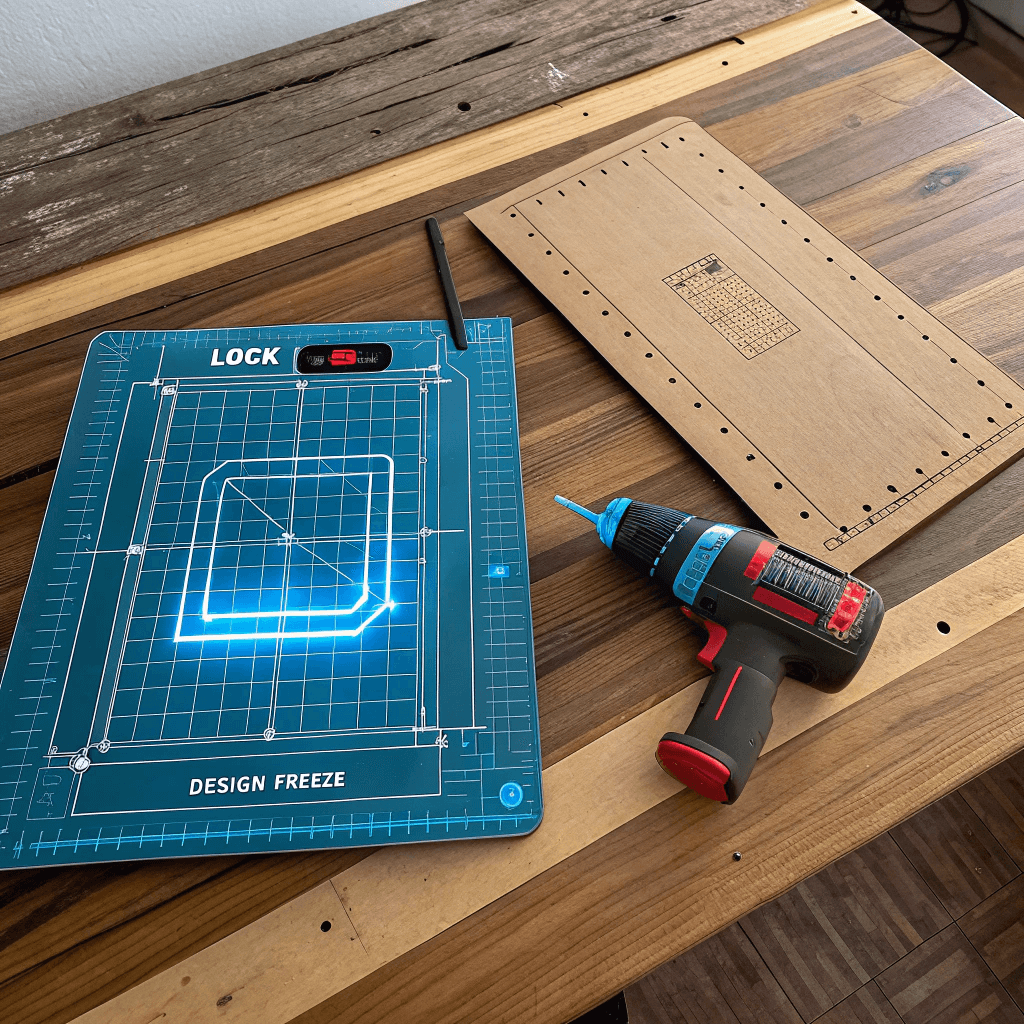
You cannot start tooling until the design is "frozen." Any change to the size or shape after the metal is cut requires re-tooling 5. I always advise clients: "Measure twice, cut once." Do not authorize the mold deposit until you have tested a physical prototype and are 100% sure of the dimensions.
Can you make the mold while reviewing artwork? Yes. For paper boxes, I often authorize the cutting die creation while we are still finalizing the print color. This saves a few days. However, for injection molds, never start tooling until the structural design is approved. The risk of a design change rendering a $5,000 mold useless is too high.
Why does it take longer than quoted?
You should not just wait for the final product. For expensive molds, ask for photos of the CNC machining 7 process. Once the mold is done, demand "T1 Samples" (Test 1). These are the first raw parts out of the mold. They might have rough edges, but they prove the geometry is correct.
Molds don’t last forever. A steel rule die might last for 100,000 hits; a high-hardened steel injection mold can last for a million. Ask your supplier about the tooling lifecycle 8. For long-term projects, clarify who pays for replacement or maintenance when the tool wears out.
Remember, if you pay for it, you own it. Ensure your contract states that the physical tooling asset 9 belongs to you. This is crucial if you ever need to move production to a different factory; you can crate up your mold and ship it, saving weeks of lead time at the new facility.

| Tooling Type | Material | Typical Lead Time | Cost Range |
|---|---|---|---|
| Steel Rule Die | Wood/Steel Blade | 3 – 5 Days | Low ($100-$500) |
| Rotary Die | Solid Metal | 7 – 10 Days | Medium ($500-$2k) |
| Aluminum Mold | Aluminum | 2 – 3 Weeks | Medium ($2k-$5k) |
| Steel Injection Mold | Hardened Steel | 4 – 8 Weeks | High ($5k-$50k) |
| Glass Mold | Cast Iron | 8 – 12 Weeks | Very High ($10k+) |
If you are in a rush or unsure about the design, ask about "Soft Tooling" or Rapid Tooling 10. This involves making a temporary mold out of softer aluminum or using 3D printed inserts. It is faster (1-2 weeks) and cheaper, but the mold will only last for a few thousand units. It is an excellent bridge strategy to get products to market while the "Hard Tooling" (steel production mold) is being built in the background.
Managing packaging tooling lead times is about managing the critical path. For simple boxes, it’s a minor blip; for custom rigid plastics or glass, it is the main event. By understanding the physics of mold-making and enforcing a strict "design freeze" before authorizing the spend, you prevent the costly loops of revisions and re-tooling. Always add a buffer week to the quoted timeline, and remember: a rushed mold often leads to a flawed product.
How long does it take to create the mold or cutting die for my custom packaging?
For paper packaging (cutting dies), it takes 3 to 7 days. For plastic or glass (injection/blow molds), it takes 4 to 10 weeks.
What is the average lead time for making a new tooling set?
"Average" depends on the material. A standard steel rule die for a mailer box is usually ready in 5 working days. A multi-cavity steel mold for a plastic cap averages 30 to 45 days.
Can the mold be made at the same time as I am reviewing other samples?
Yes, but it is risky. You can start the mold while reviewing artwork proofs, but you should never start the mold before the structural sample is approved. If the structure changes, the mold becomes scrap metal.
What can cause delays in the mold-making process?
Common delays include: 1. Design flaws that require CAD revisions. 2. Sourcing special steel for high-durability molds. 3. Debugging (the mold is made, but the parts aren’t ejecting correctly, requiring adjustments).
Will I receive a photo or confirmation once my mold is ready?
You should insist on it. Ask for a video of the mold in action (cycling) and photos of the T1 samples (first shots). Do not approve mass production until you have seen these physical proofs that the tool works.
1. Explanation of steel rule dies for packaging production. ↩︎
2. Technical definition of rotary dies for high-volume cutting. ↩︎
3. Overview of the injection molding manufacturing process. ↩︎
4. How blow molding is used for bottles and hollow shapes. ↩︎
5. Cost implications of re-tooling in manufacturing. ↩︎
6. The role of CAD/CAM software in mold design. ↩︎
7. Comparison of CNC machining versus 3D printing for parts. ↩︎
8. Strategies for maintaining molds to extend their life. ↩︎
9. Understanding tooling as a capital asset in business. ↩︎
10. Rapid tooling technologies for fast product development. ↩︎
You can leave any questions. We will see and answer you.