Zibo City, Shandong Province

Have Any Questions?

10 AM – 6 PM
Zibo City, Shandong Province
Have Any Questions?
10 AM – 6 PM

Have Any Questions?

In the world of supply chain management, "Lead Time" is the most debated metric. I have seen marketing teams plan product launches based on a 10-day production promise, only to miss the deadline because they didn’t account for the 3 days it takes to order paper or the 5 days required for hand-assembly. When sourcing custom packaging from China, a realistic timeline is your best defense against chaos.
The gap between "placing an order" and "shipping the goods" varies wildly depending on the complexity of your box. A simple printed carton is fast; a luxury gift box with magnetic closures is slow. This guide is my timeline playbook. I will break down the typical production windows for different packaging types, explain exactly when the clock starts ticking, and highlight the seasonal disruptions—like Chinese New Year—that you must plan for to keep your supply chain moving.
A common rookie mistake is thinking the lead time starts when you send the Purchase Order (PO). It does not. In China, the production clock starts only when two things happen: 1) You formally approve the Golden Sample 1, and 2) The factory receives your deposit. Until the money hits their bank, they will not order the raw paper.
Simple folding cartons 2 (like cosmetic boxes or cereal boxes) are the fastest to produce. The process is highly automated: print, die-cut, glue, and fold. Once the paper arrives, a factory can churn out tens of thousands of units per day.
Corrugated boxes 3 take slightly longer. This is because the printed top sheet (litho-lam) often needs to be laminated onto the corrugated flute, which requires drying time to prevent warping. The die-cutting and stripping process for thick board is also slower than for thin paper.
This is where timelines stretch. Rigid box manufacturing 4 involves wrapping a paper "skin" around a greyboard skeleton. While machines help, much of this is still done by hand or semi-auto equipment to ensure perfect corners. This manual labor creates a bottleneck, especially for large orders.
Factories rarely keep custom paper in stock. If you choose a standard white board, they can get it in 2 days. If you specify a niche textured paper 5 from a specific mill, it might take 10 days just for the material to arrive at the factory. Always ask: "Is this paper in stock?"
Do not forget the end of the line. After the boxes are made, they must be inspected, packed into master cartons, and palletized. A thorough quality control inspection 6 takes 1-2 days. If defects are found and re-work is needed, this adds more time. This "finishing phase" is part of the production lead time.
The Chinese New Year 7 holiday is a massive supply chain event. Factories close for 2-4 weeks in January or February. However, the disruption starts a month before (the "rush") and lasts a month after (worker shortages).
Can you pay for speed? Sometimes. You can pay for "rush" production, which usually means the factory runs overtime shifts. However, you cannot speed up glue drying or ink curing without risking quality. The real lever for speed is air freight 8, which cuts shipping from 30 days to 5 days, but costs significantly more.
Lead time quotes (e.g., "20 Days") almost always refer to production time only. They do not include shipping. You must add the ocean freight transit time 9 (25-40 days to the US) plus customs clearance (3-7 days) to get your true "dock-to-dock" timeline.
Manufacturing is unpredictable. Machines break, power outages happen, and humidity affects drying. I always add a "buffer" of 5-7 days to any timeline the factory gives me before promising a delivery date to my stakeholders. This is basic supply chain risk management 10.

| Packaging Type | Complexity | Production Lead Time | Risk Factors |
|---|---|---|---|
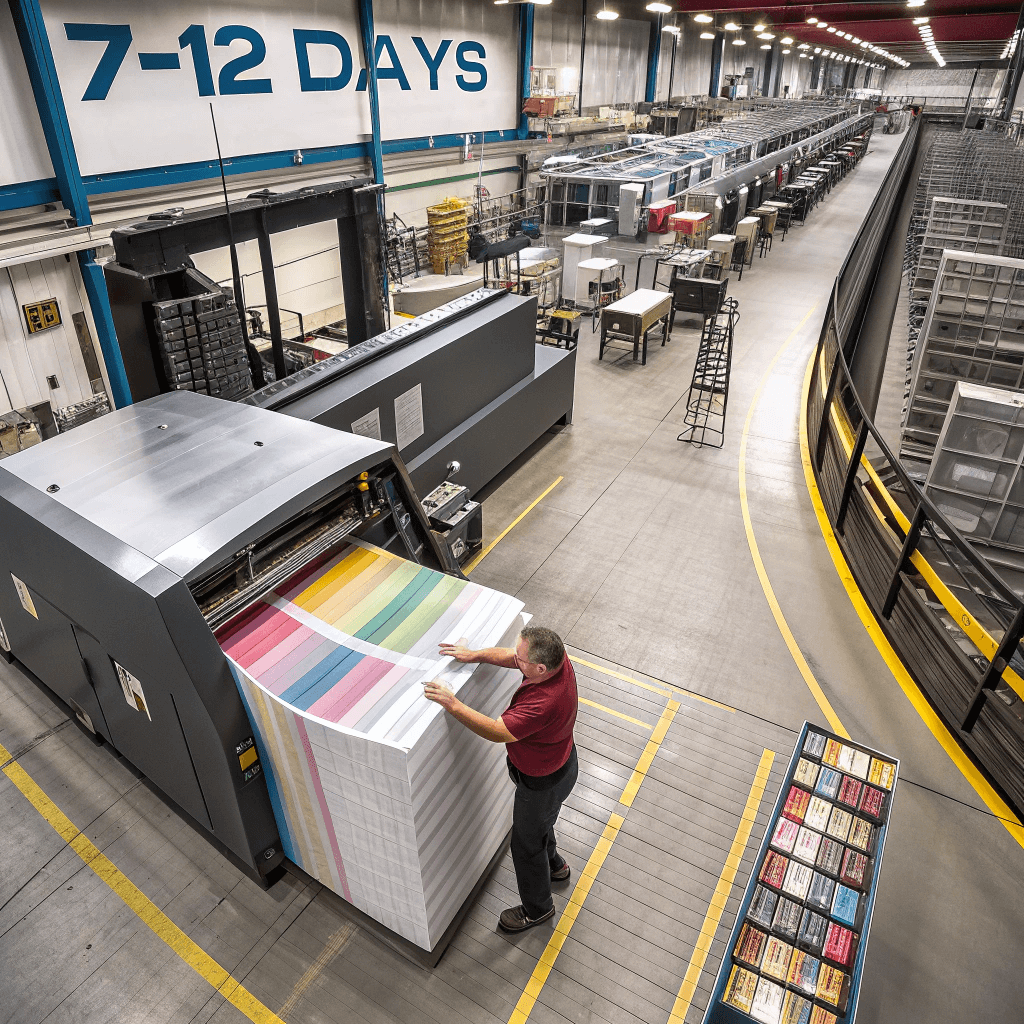
| Folding Carton | Low | 7 – 12 Days | Ink drying, die wear |
| Corrugated Box | Medium | 10 – 15 Days | Warping, lamination bubbles |
| Rigid Gift Box | High | 15 – 25 Days | Hand assembly speed, glue drying |
| Molded Pulp | Medium | 14 – 20 Days | Drying time, mold capacity |
To ensure the fastest possible turnaround:
A realistic production lead time is a calculation, not a guess. It is the sum of material procurement, machine setup, run time, assembly, and packing. By understanding that a rigid box takes twice as long as a folding carton, and by respecting the "blackout" period of Chinese New Year, you can build a supply chain that delivers on time, every time.
What is a realistic production lead time for my custom paper packaging order from China?
For most orders, 15 to 20 working days (3-4 weeks) is a safe, realistic average. Simple boxes can be done in 10 days; complex handmade boxes may take 30 days.
How is the lead time calculated from the day I place my order?
It is calculated from the day the deposit is received AND the final artwork/sample is approved. If you place the order on Monday but don’t approve the artwork until Friday, the clock starts on Friday.
Does the lead time include the time for quality inspections?
Usually, yes. The factory’s quoted lead time typically includes their internal QC and packing. However, if you hire a third-party inspector who finds defects that need reworking, that will add extra time.
How do Chinese holidays like Chinese New Year affect my production schedule?
Significantly. Factories close for 2-4 weeks around CNY (Jan/Feb). Production slows down 2 weeks before the holiday and takes 2-3 weeks to ramp back up afterward. It effectively creates a 6-week dead zone.
Can I pay extra for an expedited production service if I’m in a hurry?
You can ask, but results vary. Factories can run overnight shifts to shave off a few days, but they cannot cure physics (glue drying). The best way to expedite is to pay for Air Freight for shipping, or at least for a portion of the order.
1. The definition and importance of a Golden Sample in QC. ↩︎
2. Overview of the folding carton industry and production speeds. ↩︎
3. Technical details on corrugated flute types and manufacturing. ↩︎
4. Why rigid box production is labor-intensive and slower. ↩︎
5. How specialty textured papers impact procurement timelines. ↩︎
6. The role of QC inspections in the production timeline. ↩︎
7. Calendar of Chinese public holidays affecting manufacturing. ↩︎
8. Cost and speed comparison of air freight vs ocean freight. ↩︎
9. Understanding transit time in international logistics. ↩︎
10. Strategies for mitigating supply chain delays and risks. ↩︎
You can leave any questions. We will see and answer you.